-
- Picnic BlanketBeach TowelBeach BagBeach Chair CoverTable Cloth CoverBeach MatCamping MatLunch BagHammockCamping Chair
-
Pros and cons of different insulated lunch bag materials.
Views: 0 Author: Site Editor Publish Time: 2026-07-08 Origin: Site


Consumers often encounter marketing claims promising "24-hour cooling" for a standard lunch container. These claims rarely align with the physical realities of thermal degradation and physical food protection. Understanding the materials used in your lunchware is the only way to ensure your food stays safe and intact.
Selecting the wrong materials leads to serious consequences. Poor insulation fails to meet USDA food safety temperature guidelines, risking bacterial growth. Weak structural materials cause catastrophic collapses that squish delicate food during a commute. Substandard stitching creates premature tearing at stress points, while porous inner seams allow toxic mold to accumulate over time.
This guide provides an evidence-based breakdown of the three critical layers of an insulated lunch bag: the outer shell, the insulation core, and the inner lining. By evaluating these materials, buyers can make informed decisions to select a product that perfectly matches their specific durability, safety, and thermal requirements.
- Thermal Synergy: Effective temperature retention relies on the combination of a high-density foam core (like EVA) and a reflective or sealed inner lining (like PEVA or aluminum).
- Durability vs. Aesthetics: Outer shell materials dictate the product's lifespan; high-denier polyester (600D to 1000D) and nylon resist abrasions, tears, and environmental moisture, while cotton blends prioritize eco-friendliness over ruggedness.
- Food Safety and Certified Non-Toxicity: Non-toxic, BPA-free, lead-free, and phthalate-free materials with seamlessly welded inner linings are non-negotiable for preventing bacterial growth and ensuring easy sanitization.
- Crush Protection: The structural stiffness of the insulation material dictates whether the lunch bag can prevent sandwiches and soft fruits from being squished during transit.
- Contextual Selection: The "best" material depends entirely on the use case—weighing environmental conditions (e.g., climate-controlled office vs. outdoor job site) against material trade-offs like weight, flexibility, and washability.
Success Criteria: The Anatomy of a High-Performance Insulated Lunch Bag
Thermal Retention Standards and Food Safety
The USDA defines the "Danger Zone" as the temperature range between 40°F and 140°F. Within this zone, foodborne illness bacteria multiply rapidly. High-performance insulation is vital to keep perishable items below 40°F until consumption. Without adequate thermal protection, a packed lunch becomes a health hazard. You cannot rely on ambient air conditioning to keep a poorly insulated container safe.
Baseline expectations for thermal retention typically range from 4 to 6 hours when using standard ice packs. Material density governs this performance. Denser foams trap more air in closed cells, slowing heat transfer. Active cooling compatibility is also necessary. Materials must handle direct contact with ice packs without sweating or degrading. When you place a frozen gel pack against a thin, low-density foam, the cold transfers too quickly to the exterior, causing condensation and rapid temperature loss inside the main compartment.
Structural Integrity, Tear Resistance, and Mechanical Stress Testing
A high-quality insulated lunch bag must meet specific engineering benchmarks. Handle pull-strength determines if the bag can carry heavy glass containers without snapping. Heavy-duty zipper cycle limits ensure the main closure won't fail after a few months of daily use. Tear resistance under load proves the fabric can handle the abuse of being tossed into truck cabs or lockers.
Structural resistance metrics are equally critical. A bag must prevent physical collapse to shield interior contents. Delicate sandwiches and glass meal-prep containers require a rigid or semi-rigid structure to survive drops and impacts during a busy commute. Soft-sided bags without a rigid core will fold under the weight of a thermos or a heavy textbook resting on top of them.
Maintenance, Sanitization, and Condensation Management
Ease-of-cleaning serves as a primary success metric. Materials must withstand daily chemical wipe-downs or soapy water without degrading. Food spills are inevitable, and the interior must not absorb liquids or odors. If a container requires specialized cleaning solutions just to remove a spilled yogurt stain, it fails the practicality test for daily use.
Condensation management involves the physics of heat transfer. When cold air inside the bag meets a warm, humid external environment, condensation forms. High-quality materials prevent this "sweating" from penetrating the outer shell, keeping your hands and surrounding items dry. A bag that leaves a puddle on your desk is utilizing substandard insulation barriers.
Outer Shell Materials: Evaluating Durability and Protection
Nylon and High-Denier Polyester (600D to 1000D)
High-denier polyester and nylon offer exceptional abrasion resistance, scoring highly on Martindale testing scales. These synthetic fabrics are inherently water-repellent, especially when treated with Durable Water Repellent (DWR) coatings. They resist staining and wipe clean easily, making them ideal for rugged use on job sites or outdoor environments.
However, these materials can feel rigid or bulky. Higher denier counts also increase manufacturing costs, making premium polyester and nylon bags more expensive than basic alternatives. The stiffness of 1000D polyester means the bag will not fold flat for storage, which can be a drawback for users with limited cabinet space.
Material Type Abrasion Resistance Water Repellency Flexibility 600D Polyester High Moderate (requires DWR) Moderate 1000D Nylon Very High High Low (Rigid) Cotton Canvas Low Poor High Vinyl, PVC, and Neoprene
Neoprene provides inherent secondary insulation, structural elasticity, and impact cushion. Vinyl offers a highly impermeable, cheap, and stain-resistant barrier. Both materials are common in budget-friendly options and novelty designs.
The drawbacks are significant. Uncoated neoprene absorbs exterior spills, sweats heavily, and retains deep-set food odors. Vinyl becomes brittle and cracks over time under UV exposure. Legacy PVC raises environmental and toxicological concerns due to phthalate content. We strongly advise against using legacy PVC materials for any container meant to hold consumable goods.
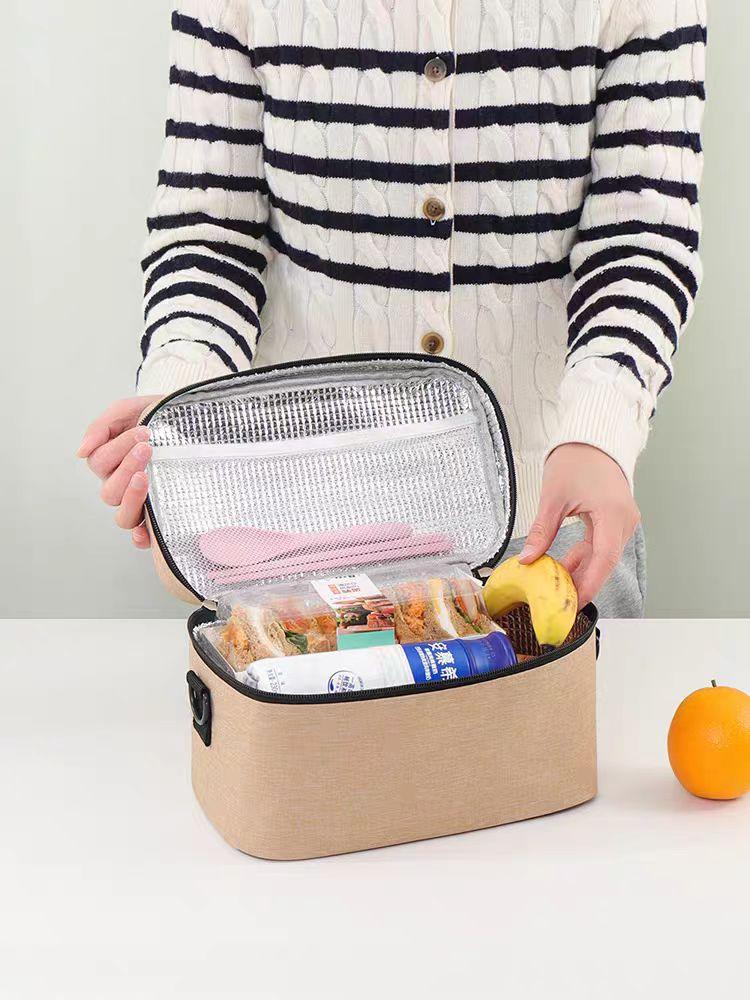
Cotton and Canvas Blends
Cotton and canvas blends are eco-friendly, biodegradable, and aesthetically versatile. They are often machine washable, appealing to users who prioritize natural materials and easy maintenance. You will often see these materials used in tote-style designs.
These materials suffer from poor moisture resistance unless treated with chemical wax or polyurethane coatings. They offer zero inherent impact protection, lower tear strength, and are highly prone to mold if stored damp. A canvas bag left in a hot car with a spilled drink inside will develop mildew within 48 hours.
The Insulation Core: Density, Thickness, and Thermal Dynamics
EPE (Expanded Polyethylene) Foam
EPE foam is extremely lightweight and highly cost-effective. It provides standard thermal resistance suitable for short commutes and basic temperature control. Manufacturers favor EPE for entry-level products because it is easy to cut and sew into various shapes.
Unfortunately, EPE is highly susceptible to compression over time. This leads to micro-collapses in the foam structure, permanently reducing its insulating properties. It also offers minimal protection against external physical impacts. If you press your thumb hard into EPE foam, it often leaves a permanent indentation, which represents a permanent loss of thermal resistance in that specific spot.
EVA (Ethylene-Vinyl Acetate) and High-Density Polyurethane (PU)
EVA and high-density PU offer superior structural rigidity. This prevents the insulated lunch bag from collapsing and squishing food. They provide exceptional cold and heat retention due to their dense closed-cell chemistry, resisting crushing, twisting, and impact.
The trade-off is an increase in the overall weight, footprint, and manufacturing cost of the bag. These materials are found in premium, heavy-duty products designed for harsh environments. When evaluating a bag with an EVA core, you will notice it holds its shape perfectly even when completely empty.
- Test the foam density by squeezing the side panels; high-density EVA will resist compression.
- Check the thickness of the core; a minimum of 5mm is required for adequate thermal retention.
- Inspect the corners and seams to ensure the foam core extends fully without gaps.
Inner Linings: Food Safety, Reflectivity, and Leak Prevention
Aluminum Foil (Thermal Foil)
Aluminum foil provides excellent radiant heat reflection. It is highly effective for short-term temperature maintenance of both hot and cold items by reflecting thermal radiation back into the compartment. It is a very common lining in budget-tier products.
Foil is prone to micro-tears, flaking, and crinkling over time. A punctured foil lining exposes the foam core to internal condensation, food spills, and bacterial harboring, ruining the bag. Once the foil barrier is breached, the underlying foam acts like a sponge for any spilled liquids.
PEVA (Polyethylene Vinyl Acetate) and TPU (Thermoplastic Polyurethane)
PEVA and TPU are FDA-compliant, food-safe, PVC-free, and phthalate-free. They allow for seamless heat-welding, creating a truly leakproof interior void of stitched seams. They are highly flexible and effortless to sanitize with a simple wipe-down.
These materials have lower radiant reflection compared to pristine aluminum foil. They can also warp or melt if exposed directly to extreme heat, such as freshly microwaved containers straight from the stove. Always let hot containers cool slightly before placing them directly onto a PEVA lining.
Evaluation Dimensions: Matching Materials to Specific Use Cases
Heavy-Duty and Outdoor Environments (Construction, Field Work)
For construction sites or field work, a 1000D polyester or heavy-duty TPU-coated nylon outer shell is recommended. Pair this with a thick molded EVA core and a thick heat-welded TPU lining. The environment demands materials that can withstand being dropped on concrete or exposed to dust and rain.
This combination prioritizes high impact resistance, protection against dropping, maximum thermal retention in extreme weather, and complete puncture resistance. A worker needs to know their meal will survive the back of a pickup truck and still be cold at noon.
Office and Commuter Environments
Office workers benefit from a treated nylon or high-quality canvas outer shell. An EPE or thin EVA foam core combined with a PEVA lining works well. The primary goal here is portability and a clean aesthetic that fits into a professional setting.
This setup balances professional aesthetics, lightweight portability, and adequate thermal retention for climate-controlled transit without unnecessary bulk. You do not need a 1000D polyester shell if the bag only travels from a car seat to an office refrigerator.
School and Pediatric Use
Children need a machine-washable cotton or flexible neoprene outer shell. An EVA core provides structural crush-protection, while a seamless PEVA lining ensures safety. Kids are notoriously rough on their belongings, and spills are a daily occurrence.
This configuration focuses on strict non-toxicity (BPA-, lead-, and phthalate-free certifications), ease of deep cleaning for spill mitigation, and soft-sided impact safety to prevent squished fruit. A heat-welded lining is mandatory here to prevent spilled juice boxes from ruining the insulation core.
Implementation Risks and Material Degradation
The Mold and Mildew Trap (Seam Failures vs. Heat Welding)
Stitched inner linings allow liquids to penetrate the insulation core. When soup spills or condensation pools, moisture seeps through the needle holes. This leads to irreversible mold growth and dangerous odors inside the foam. Heat-welded seams prevent this by creating an impermeable barrier. Always inspect the interior corners of a bag; if you see visible thread lines on the bottom lining, it is not truly leakproof.
The "Squished Food" Dilemma: Soft-Sided Collapse vs. Heavy-Duty Rigidity
Materials with low structural integrity, like thin neoprene or untreated cotton, fail to protect soft foods. During a crowded commute, these bags collapse under pressure, crushing sandwiches or bananas. Rigid EVA cores prevent this physical crushing. If you carry delicate items, you must select a bag with a rigid or semi-rigid exoskeleton.
Zipper and Handle Stress Points
Even the most advanced thermal materials will fail if paired with cheap hardware. Low-quality nylon zippers break, non-waterproof zipper tracks leak cold air, and unreinforced handle stitching tears under the weight of a full meal. Look for heavy-duty coil zippers and box-stitched handle reinforcements. A broken zipper renders the thermal insulation completely useless.
Mitigation: Proper Cleaning and Storage Protocols
Extend material lifespan with proper care. Avoid abrasive scrubbers on foil linings to prevent tearing. Air-dry completely to protect PEVA from mildew. Use mild detergents on the outer shell to maintain water-repellent coatings. Never store the bag fully zipped closed if the interior is even slightly damp.
Conclusion
- Audit your daily commute environment to determine if you need heavy-duty abrasion resistance or lightweight portability.
- Measure your standard food containers to ensure they fit within the rigid dimensions of an EVA-core bag without forcing the zippers.
- Inspect the interior lining of your current bag and immediately discard it if you find punctures or mold in the seams.
- Upgrade to a bag with heat-welded PEVA or TPU linings to guarantee a leakproof and sanitary food storage environment.
FAQ
Q: How long does an insulated lunch bag keep food cold?
A: A quality bag with a high-density EVA core keeps food cold for 4 to 6 hours using standard ice packs. Thicker insulation and sealed zippers can extend this timeframe up to 8 hours depending on ambient temperatures.
Q: Is PEVA or aluminum foil better for the inside of an insulated lunch bag?
A: PEVA is superior for long-term durability and leak prevention because it supports heat-welded seams. Aluminum foil reflects heat better initially but tears easily, which allows bacteria to harbor in the foam core.
Q: Are neoprene lunch bags safe for direct food contact?
A: Neoprene itself is not safe for direct food contact. It absorbs spills, retains moisture, and holds onto odors. Always use sealed containers inside a neoprene bag rather than placing loose food inside.
Q: How do you clean the inside of an insulated lunch bag without damaging it?
A: Wipe the interior with a damp cloth and mild dish soap. Avoid abrasive sponges that can scratch PEVA or tear foil. Leave the bag open to air-dry completely before storing to prevent mold growth.
Q: Do cotton lunch bags provide any insulation?
A: Cotton provides zero inherent insulation on its own. It requires an internal foam core and a reflective lining to maintain safe food temperatures. Untreated cotton will also absorb external moisture rapidly.