-
- Picnic BlanketBeach TowelBeach BagBeach Chair CoverTable Cloth CoverBeach MatCamping MatLunch BagHammockCamping Chair
-
Best insulated lunch bags of 2026 compared for work, school, and travel.
Views: 0 Author: Site Editor Publish Time: 2026-07-06 Origin: Site


Packing a daily meal often ends in frustration. You open your bag to find lukewarm food, crushed sandwiches, and condensation soaking into your electronics. Cheap lunch boxes degrade rapidly under daily use. The gap between marketing claims and real-world performance is vast. Many products advertise all-day cooling but rely on thin, low-density foam. Their stitched seams fail during standard commutes. Worse, cheap materials can leach harmful chemicals when exposed to heat.
We conducted a rigorous, evidence-based evaluation of the top models for 2026. We categorized our findings by specific use cases, including office commutes, school environments, and long-distance travel. Our testing graded each insulated lunch bag on thermal retention, material durability, non-toxic safety standards, and cleanability. You will learn exactly which features matter and how to choose a container that protects your food and your gear.
- Thermal Performance Baseline: High-quality insulated lunch bags should maintain safe food temperatures (below 40°F) for a minimum of 6–8 hours with standard ice packs.
- Material Safety & Durability: Food-grade PEVA or welded TPU linings vastly outperform traditional aluminum foil linings in both leak resistance and mold prevention. Ensure all linings are third-party certified BPA-free, lead-free, and PFAS-free.
- Use-Case Dictates Form: Professionals require compact, structured designs to prevent crushing, while travelers and meal-preppers benefit from expandable, soft-sided cooler hybrids.
- The Zipper and Hardware Trade-Off: True leakproof performance requires waterproof zippers (like YKK AquaGuard) and marine-grade hardware, which inherently require more force to open and close but prevent catastrophic failures.
- The Physics of Cold: Top-loading ice pack compartments are superior to side pockets, as cold air naturally sinks, ensuring uniform temperature distribution throughout the container.
Evaluation Criteria: How We Assess an Insulated Lunch Bag
A viable daily-use lunch bag must meet strict baseline requirements. We demand high thermal performance, structural integrity, and verified chemical safety. A bag failing any of these criteria risks foodborne illness or damaged personal items. We break down our testing methodology below to show exactly how we separate reliable gear from cheap imitations.
Thermal Retention Testing Methodology
We tested each model in two distinct environments. The first simulated a standard office at 72°F. The second replicated an extreme hot vehicle interior at 105°F. We measured core temperature degradation over 4, 8, and 12-hour intervals. Digital temperature probes embedded in standardized food containers tracked the exact moment temperatures breached the safe 40°F threshold. We used identical ice packs across all tests to ensure a level playing field. Bags that failed to hold temperatures below 40°F for at least six hours were immediately disqualified from our top recommendations.
Condensation and Sweat Resistance
Moisture breakthrough ruins documents and electronics. We tested exterior fabrics to ensure zero sweating. A high-quality container must remain completely dry on the outside, making it safe to pack alongside laptops and tablets. We packed each bag with maximum ice capacity and placed them in a high-humidity chamber. We then checked the exterior shell every hour with moisture-detecting paper. Bags utilizing proper closed-cell foam barriers passed this test easily, while those with thin open-cell foam immediately showed wet spots.
Material, Build Quality, and Safety Standards
Exterior durability requires minimum denier ratings. We look for 600D polyester or 840D TPU-coated nylon to resist abrasions. Insulation density matters heavily. We evaluate the thickness of closed-cell foam, preferring 8mm EVA over standard 5mm variants. Chemical safety screening is non-negotiable. We verify manufacturer certifications for FDA compliance and California Prop 65. The materials must be free of phthalates, BPA, and fluorinated forever chemicals.
Material Type Durability Rating Thermal Efficiency Best Use Case 600D Polyester Moderate Standard (with 5mm foam) Office and light commutes 840D TPU-Coated Nylon High Excellent (with 8mm foam) Construction and field work PEVA Lining High (Tear Resistant) High (Reflective) Daily meal prep and school Aluminum Foil Lining Low (Prone to cracking) Moderate Budget or infrequent use Leak Resistance and Cleanability
Water-resistant exteriors differ entirely from leakproof interiors. High-frequency heat-welded seams outperform stitched seams. Welded seams prevent liquid pooling, deep-seated odors, and bacterial growth. You can wipe them clean in seconds. We poured two cups of dyed water directly into the main compartments of each bag, zipped them shut, and inverted them for ten minutes. Only bags with welded TPU or PEVA liners and waterproof zippers kept the liquid contained.
Hardware and Load-Bearing Durability
We stress-tested zippers, shoulder strap D-rings, and carry handles. A standardized 10-lb load simulated heavy glass meal-prep containers. Hardware must withstand sudden drops and constant tension without snapping or fraying. We performed a drop test from a height of four feet onto concrete. We checked for cracked buckles, torn stitching at the handle joints, and zipper track separation. Bags utilizing metal D-rings and reinforced bar-tack stitching survived without issue.
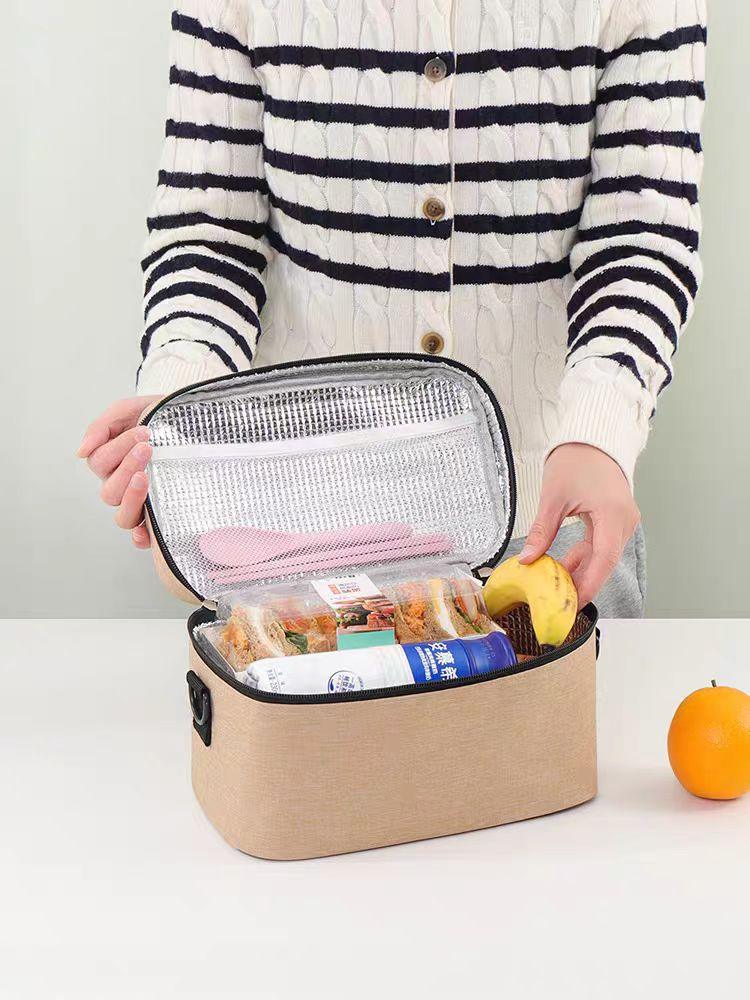
Top Insulated Lunch Bags for Professionals (Work & Office)
Professional environments demand sleek aesthetics and compact footprints. These models feature condensation-free exteriors and fit standard glass meal-prep containers perfectly. You need a bag that looks appropriate in a boardroom but performs like a heavy-duty cooler.
Model A – Best Overall for the Office
This model offers a 6-liter capacity and utilizes 8mm closed-cell EVA foam. The exterior features a 600D water-repellent polyester shell. It holds FDA and OEKO-TEX safety certifications. The dimensions are specifically tailored to hold two standard rectangular glass containers stacked vertically, leaving enough room for an ice pack on top.
During testing, it maintained safe temperatures for 8.5 hours at 72°F. The exterior remained completely dry during our condensation tests. The sleek professional aesthetic blends into office environments. The leakproof welded liner handles spills easily. However, the rigid structure limits expansion capacity. You cannot overstuff this bag with bulky fruit or large thermoses. It is ideal for commuters who need a slim, modern bag that fits inside a larger backpack or briefcase without sweating or leaking.
Model B – Best Minimalist / Tote Design
This tote-style bag provides an 8-liter capacity with a flexible, unstructured design. It uses 5mm polyethylene foam insulation and features vegan leather handles. The lining is a seamless, food-grade PEVA. The roll-top closure secures with heavy-duty magnets rather than a zipper, allowing for quick access.
Real-world testing showed it keeps items cold for about 5 hours. It excels at keeping hot items warm for short trips. The wide mouth makes cleanability exceptional. You can invert the entire lining to wipe it down. The stylish handbag-style design is a major pro, but the magnetic closure allows some air exchange, resulting in slightly lower thermal retention compared to airtight zippers. It is perfect for office workers utilizing shared refrigerators who primarily need stylish transport protection and light insulation.
Most Durable Insulated Lunch Bags for School and Heavy Daily Use
School environments destroy weak gear. We focused on impact resistance, crush-proof structural integrity, ease of use for smaller hands, and extreme cleanability. These bags survive being kicked, dropped, and dragged.
Model C – Best for Rough Handling
This bag features a removable hard-plastic liner inside a soft shell. It uses reinforced double stitching, a heavy-duty #10 YKK zipper, and impact-resistant rubberized bumpers on the bottom corners. The hard liner acts as a shield against crushing forces.
Drop-test results from school-locker heights proved its worth. It provided total crush-resistance for soft foods like fruit and sandwiches. The unrivaled durability and easy-wipe interior make it a top performer. The main drawback is a heavier empty weight and a rigid footprint that cannot compress when empty. It is the ultimate choice for students and parents needing a lunch bag that survives being thrown into lockers, gym bags, and playgrounds.
Model D – Best High-Capacity for Meal Prep
This model boasts a multi-compartment design with dual-temperature zones. It includes expandable mesh pockets on the exterior for water bottles. The internal divider allows you to separate hot thermoses from cold snacks without temperature bleed.
In our tests, the thermal barrier effectively isolated a 180°F soup thermos from a 35°F yogurt container for six hours. The excellent organization and large capacity are unmatched. However, the bulky footprint does not fit well into standard school cubbies or small backpacks. It serves best for student-athletes, shift workers, or anyone carrying multiple meals and shakers for 12+ hour days.
High-Performance Cooler Bags for Travel and Commuting
Long transits require maximum thermal retention, comfortable ergonomics, and weather resistance. These bags are built for outdoor use, transit-heavy commutes, or long-haul travel where refrigerators are unavailable.
Model E – Best for Long Commutes (12+ Hour Retention)
This heavy-duty cooler uses high-density closed-cell foam that is 15mm thick. It features a waterproof YKK AquaGuard zipper, a welded TPU exterior, and MOLLE webbing for attaching extra gear. The construction mirrors high-end whitewater rafting equipment.
It delivered sustained temperature control under direct sunlight and inside hot vehicle interiors, keeping food below 40°F for over 14 hours. The unmatched ice retention and fully waterproof construction are incredible. The trade-offs include a premium price point and stiff zipper operation that requires occasional lubrication. It is the definitive choice for field workers, construction crews, road trippers, or those without access to a fridge for 10 to 14 hours.
Model F – Best Soft-Sided Cooler Hybrid
This hybrid bag offers convertible backpack and messenger strap configurations. It includes external dry storage pockets for keys and phones, secured by safety buckles. The interior holds up to 18 cans or multiple large meal prep containers.
Load-bearing comfort during extended wear is excellent due to the padded shoulder straps. It remains stable when fully loaded. The versatile carrying options and high volume make it highly adaptable. However, it is overkill for standard office desk environments and takes up significant space. It fits hybrid commuters, air travelers, or weekend hikers needing a dual-purpose bag for daily lunches and outdoor day-trips.
Trade-Offs and Buying Considerations
No single bag does everything perfectly. You must weigh the compromises inherent in lunch bag engineering based on your daily routine. Understanding these trade-offs prevents buyer's remorse.
Soft-Sided vs. Hard-Lined Interiors
Soft-sided bags offer flexibility. They compress when empty, saving space in your backpack on the commute home. However, they offer little protection against crushing. Hard-lined interiors feature removable plastic inserts. These inserts are crush-proof, highly sanitizable, and completely leak-proof. You can throw the hard liner in the dishwasher. The downside is that hard liners add weight and maintain a rigid, bulky shape regardless of how much food is inside.
Zipper Quality vs. Accessibility
Standard nylon coil zippers provide smooth, easy one-handed operation. Children can open them without struggling. However, they are prone to leaking if the bag tips over, and they allow cold air to escape through the teeth. Waterproof zippers, like the Tizip or YKK AquaGuard, guarantee zero liquid escape and create an airtight thermal seal. The trade-off is stiffness. They require significant force to pull and need regular lubrication with silicone grease to prevent binding.
Ice Pack Placement: Convection vs. Conduction
The thermal dynamics of ice pack placement dictate how well your food stays cold. Many bags feature internal top mesh pockets for ice packs. This utilizes gravity-fed cold air circulation. Cold air naturally sinks, creating a convection current that cools the entire compartment evenly. Placing ice packs in side pockets relies on conduction, which only cools the items directly touching the ice pack, leaving items on the opposite side vulnerable to spoilage.
Material Safety vs. Stain Resistance
The industry is shifting away from fluorocarbon-based DWR coatings. These coatings provided excellent oil and stain resistance but contained harmful PFAS chemicals. Eco-friendly, PFAS-free alternatives are now the standard for safety. The compromise is that these newer fabrics may absorb oil stains more readily. You must wipe away spills immediately to prevent permanent discoloration on the exterior shell.
Common Failure Points and Maintenance (Implementation Risks)
Even the best gear degrades if abused. Understanding how these bags fail allows you to prevent premature wear, structural breakdown, and hygiene issues.
Seam Tearing and Insulation Compression
Overloading the bag with heavy glass containers stresses interior seams. When you force a zipper closed over an overstuffed compartment, the tension creates micro-tears in the lining. Condensation enters these tears and compromises the closed-cell foam layer. Once the foam gets wet, it loses its insulating properties and begins to harbor bacteria. Always leave at least an inch of clearance between your food containers and the zipper line.
Odor Retention, Mold, and Deep-Seated Mildew
Moisture trapped underneath non-removable fabric liners causes rapid mold growth. If your bag smells sour, mildew has likely penetrated the stitching. You must take actionable maintenance steps to prevent this. Never put an insulated bag in a washing machine. The agitation delaminates waterproof backings and crushes the foam structures. Instead, wipe the interior daily with food-safe sanitizers. Most importantly, prop the bag fully open and let it air dry completely overnight before storing it.
Conclusion
High-density, multi-layer insulation and certified non-toxic, welded liners are the modern benchmarks for quality in 2026. You no longer have to settle for leaky, underperforming lunch boxes. Choose a compact, sleek model for professional office environments where low-profile design and zero condensation are paramount. Opt for hard-lined, reinforced models for maximum durability and drop protection in schools. Select heavy-duty, waterproof hybrids for extreme thermal challenges and long transits.
- Measure your most frequently used glass or plastic food containers to ensure they fit flat inside the bag's dimensions.
- Evaluate your daily commute time and select an ice pack size that matches your required thermal retention hours.
- Check the manufacturer's warranty policy specifically for zipper failures and seam delamination before purchasing.
- Establish a daily wipe-down routine using a damp cloth and mild dish soap to prevent odor buildup.
FAQ
Q: How long does an insulated lunch bag keep food cold?
A: Without an ice pack, food reaches the FDA danger zone within two hours. With proper closed-cell foam and high-efficiency ice packs, a quality bag maintains safe temperatures below 40°F for 6 to 12 hours, depending on ambient conditions.
Q: Can you put hot food in an insulated lunch bag?
A: Yes, the thermal barrier traps heat just as effectively as cold. However, never mix hot and cold items in a single-compartment bag without a thick thermal divider, as the temperatures will neutralize each other rapidly.
Q: Are these lunch bags certified PFAS-free and BPA-free?
A: Top-tier models are certified free of these chemicals. Look for FDA food-grade compliance for interior linings and OEKO-TEX certification for external fabrics to ensure no harmful forever chemicals leach into your food.
Q: What is the difference between PEVA and aluminum foil linings?
A: PEVA offers high elasticity, ease of cleaning, and seamless weldability, making it highly leak-resistant. Aluminum foil tends to crease, crack, and flake over time, creating micro-fissures that harbor bacteria and leak fluids.
Q: Are insulated lunch bags machine washable?
A: No. Machine washing destroys the structural integrity of the closed-cell foam and ruins the waterproof seal of welded seams. Always hand wash with mild soap and water, then air dry completely.
Q: How do I prevent my lunch bag from sweating on my desk or in my laptop bag?
A: Sweating occurs when cold transfers to the exterior. High-density insulation combined with a durable outer shell prevents this thermal bridge. Cheap bags with thin foam fail this test and will cause condensation buildup.
Q: How do you remove persistent food smells from an insulated lunch bag?
A: Create a paste using baking soda and water, scrub the interior, and let it sit for 15 minutes. Alternatively, use a diluted white vinegar spray. Wipe it clean and leave it fully open for complete UV air-drying.